

Let’s talk



As a fractional CFO firm, we’ve seen first hand how companies transform when they gain strategic financial leadership. Let’s break it down.
A Controller is essential for businesses that need precise, reliable financial data. Their focus is on internal accounting processes, ensuring your books are accurate and your reports comply with regulations.
Controllers produce accurate income statements, balance sheets, and cash flow reports.
They create processes that prevent errors and safeguard assets.
Controllers track actuals against budgets, highlighting discrepancies.
They make sure your records are always ready for review.
Think of a Controller as the foundation of your financial house. Without them, even the best strategy can fail because decisions are made on unreliable data. Controllers keep your business organized, compliant, and running smoothly, but their focus is primarily on the past and present, not the future.
A CFO is more than a number-cruncher. They are strategic leaders who look beyond the day-to-day, helping businesses make smart financial decisions that drive growth, profitability, and long-term success.
CFOs project revenue, expenses, and capital needs, guiding your business toward sustainable growth.
They manage funding, debt, and investmentsto ensure your business has the resources to scale.
CFOs translate complex financial insights into actionable decisions for investors, boards, and executives.
They identify ways to improve efficiency and profitability across the company.
Unlike a Controller, a CFO focuses on the future. They don’t just report numbers they interpret them, uncover opportunities, anticipate risks, and create a roadmap for growth.
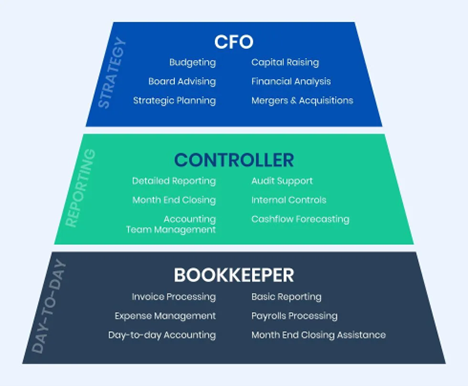
A Controller keeps your financial shipsteady, while a CFO charts the course toward new markets, higher profits, andlong-term sustainability. They work best together but if your goal is growth,the CFO is the game-changer.
Understanding your business’s stage helps determine which financial leader to hire.
Your books are messy or inconsistent.
Month-end closes are slow or error-prone.
You need compliance, internal controls, or audit readiness.
You’re scaling and need strategic insight.
You want to raise capital or manage investor relations.
You need to optimize operations and profitability.
Many companies start with a Controller, but as they grow, a CFO becomes essential. Fractional CFOs deliver high-level guidance on strategy, forecasting, and decision-making without the overhead of a full-time executive, giving smaller and mid-market businesses access to expertise usually reserved for large enterprises.
Controllers provide the accurate financial foundation, and CFOs use that foundation to make strategic decisions.
1. Controller prepares monthly financial statements.
2. CFO analyzes the data for trends, risks, and opportunities.
3. CFO advises leadership on growth, investments, and efficiency improvements.
For growing companies, a CFO isn’t a luxury, it’s a strategic necessity. By focusing on the future, driving operational efficiency, and making smart capital decisions, a CFO turns your financial data from a historical record into a roadmap for success.
Ask yourself today: Is your business prepared for the future, or are you just keeping the books balanced? A fractional CFO can provide the insight and guidance to help you scale smarter, faster, and with confidence.

